
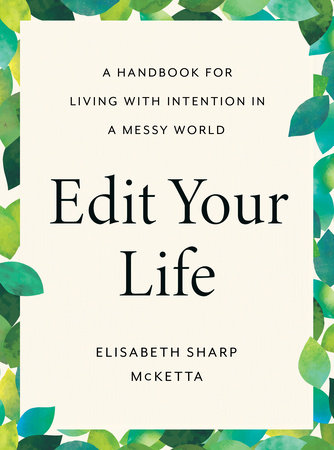
Today I’m taking part in the blog tour for Edit Your Life. I’m sharing an extract from the book with thanks to Anne Cater for inviting me on the blog tour and to the publisher for providing the extract.
Blurb:
An inspiring guide to focusing on what matters most in life—and hitting delete on what doesn’t.
Life is noisier, messier, and more complicated than ever. In our quest to keep up, we can lose sight of what we care about most, and instead try to do it all—with mixed results.
In this beautiful call to examine and edit our lives, writer Elisabeth Sharp McKetta shares eight simple ways to cut through the clutter, drama, and overwhelm of modern life to live with more intention and joy. Inspired by her own experiments with reprioritizing, tiny house living, and finding the right balance of work and family time, Edit Your Life brings together personal narrative and practical takeaway, with inspiring results.
Whether you’re pivoting, downsizing, relocating, or just ready to have more time and energy for the people and activities you love most, this engaging and practical guide will bring you on a journey of exploration and reflection—and point you toward the life you truly want to live.
Extract:
Thank you for coming to this book. I wish for it to serve as a sort of organizing book for the soul, offering ideas—both practical and philosophical—to distill any life to its ideal shape. I have tried to write it in the same way that I would speak with a friend as we sit together on the deck, watching the evening close around us, drinking wine or tea, talking late into the night about our lives.
Editing is an act of change; it requires asking “What is this now?” and “What should it be?” Editing means assessing the form something wants to take and cutting out what is unnecessary. Whether a book or a relationship, a kitchen or a parenting philosophy, the principles are the same. In this book I will use the term life-edit, which means exactly that. This book is not about home editing (though the same principles apply to curating a stance on life as to curating objects in a house), nor is it about literary editing, though I will draw upon my editing experience to share its most life-applicable skills.
Editing is a skill that helps us see anything clearly—to look, and look again. This book is about skills that transcend the specifics of our lives: Whether you have a partner or not, dependents or not, a job or a career or a calling, wherever you live and whatever you earn, you can use the principles of life-editing to rethink how you spend your hours, days, and years. I will share my own experience, and I hope you will use it to reflect upon your own experience. The details of your life are as specific to you as mine are to me—and below those details, we are all trying to live a life that is worthy of us.
Often life gets edited for us. This is unavoidable: We cannot control the world outside our homes. In many cases, we cannot control the world inside our homes. Even if we do not court change, life is full of it: we must respond both to changes that involve gain, such as falling in love, finding a new job, starting school, having a baby, moving to a new place—and to changes that involve loss, whether of a loved one, of a job, of a home, of one’s health, or (hello, pan- demic!) all of the above. Any crisis forces us to realign, let alone an unprecedented worldwide one. When we lose things that have felt certain and necessary, life gets edited for us against our will, and we are forced, often at an inconvenient time, to re-evaluate.
While defensive editing—editing in response to changes—is something we all must do at times, this book proposes proactive life-editing: not waiting for “the right time” but editing now, in whatever situation, as a way to take an active role in shaping our lives around what matters most. In this way, we can make decisions as clearly as possible about what our life needs and wants to be. We can—with a little thought, an open mind, and a willing- ness to try a few simple changes—edit our needs to their essentials, revisit and reprioritize our values, then figure out how best to go on. We have all been forced to edit and will be forced to again, and my hope is that this book takes that unavoidable fact and turns it into a quest that anyone can do with a sense of clarity, grit, self-respect, resourcefulness, and even joy.
When is the best time to edit? Most people edit when crisis comes or life changes—when the relationship fails, the money grows too tight to ignore, the unhappy work environment leads to health problems or emotional burnout, or the children are grown, or some other intervention requires us to change our stance. A wiser way to edit is in advance of that, anytime your life feels out of alignment. You can always edit your way back, or partway back, as needed—a great number of decisions in life can be revised or reversed.
The risk of waiting comes with the risk of regret: by failing to edit when our life doesn’t quite fit, we miss giving the best of our attention to our lives—wishing our lives away, wishing they were different. The risk of waiting comes too with the risk of disengagement: a sense that all our life’s parts, including its people, have been reduced to items on an endless list. This leads to a feeling of everyday claustrophobia, a grief and guilt at having abandoned the essential things.
This is why wherever you are, whenever you are reading this, if you have picked up this book with a question in your mind about your life and how it might be better, the time to edit is now.
***
Edit Your Life is available from Amazon.
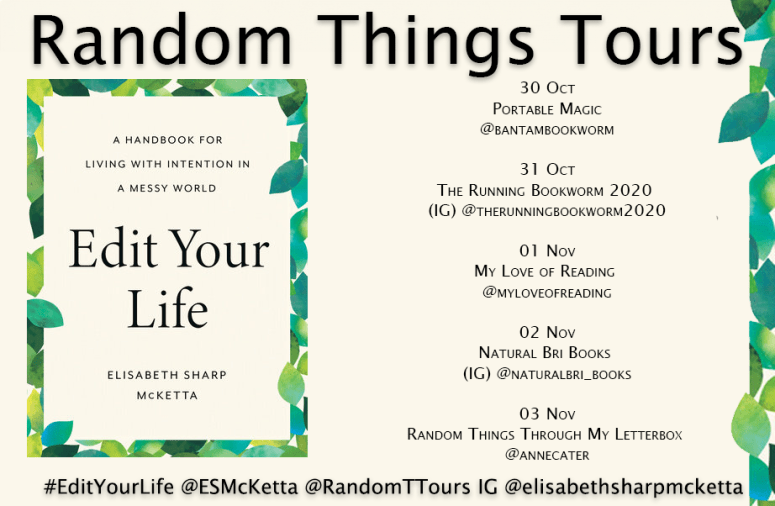
You can follow the rest of the blog tour here:
 Portable Magic