
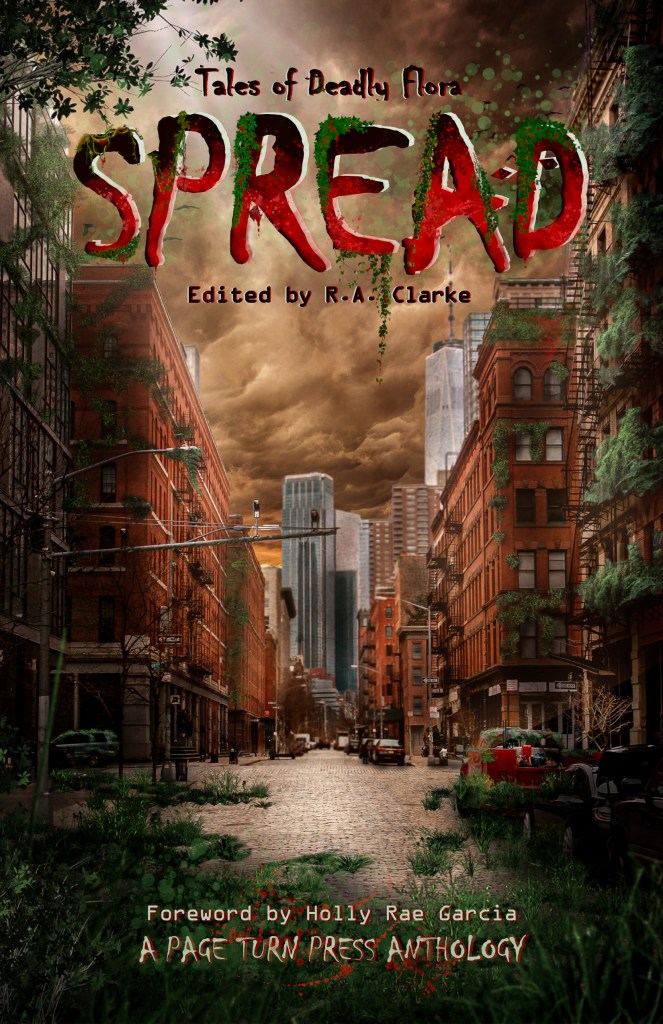
I’m joining the publication day blog tour for Spread: Tales Of Deadly Flora. I’m sharing an extract with thanks to Rachel Gilbey for inviting me on the blog tour and to the publisher for my copy of the extract.
Blurb:
Plants are beautiful, peaceful, abundant, and life-sustaining…
But what if something sinister took root in the soil, awakening to unleash slashing thorns, squeezing vines, or haunting greenery that lured you in? Perhaps blooms on distant planets could claim your heart, hitch a ride to Earth on a meteor, or simply poison you with their essence. Imagine a world where scientists produced our own demise in a lab, set spores free to infect, even bred ferns to be our friends only to witness the privilege perverted. When faced with botanical terror, will humanity fight to survive, or will they curl and wither like leaves in the fall?
Read ten speculative tales ripe with dangerous flora to find out.
Includes stories by:
Alyssa Beatty
Katie Ess
Jen Mierisch
Josephine Queen
Lisa Fox
Katie Jordan
Melissa Mendelson
Andrea Goyan
Alex Grehy
R.A. Clarke
Foreword by:
Holly Rae Garcia
Extract:
Tears of Green by Alex Grehy. In a world at war where the government has released weaponized plants, humanity may face extinction when the vegetation does their job a little too well.
“In this scenario, the first wave attack is brambles, growing at an accelerated rate of 30 centimetres an hour.” As Dr Quercus spoke, a creeping fog of green spread across the terrain almost imperceptibly. “This variety has six-inch thorns which make movement difficult, though the finer thorns are more deadly. They are easily shed from the plant, becoming embedded in the skin, where commensal bacteria rapidly initiate necrotizing fasciitis. Now please note the fertile lowlands.”
A dark green fog shimmered across the landscape, which then rapidly turned brown.
“The lucrative opium poppy crops, along with essential food crops, are being destroyed by bracken, whose toxins inhibit the growth of competing plants and also neutralize pollinating insects.”
Around the border of the hologram, tall trees seem to spring toward the ceiling.
“Sandbox trees—modified, of course. The spiny bark has a fast-acting and deadly neurotoxin. The fruit explodes on contact with the ground, scattering seeds at high speed with an impressive blast radius greater than that of a hand grenade. The fruit is also neurotoxic—if, ah, shrapnel breaks the skin, victims are incapacitated almost immediately; death occurs within an hour. The trees act as an impenetrable boundary, imprisoning the enemy until starvation forces their surrender.”
“And how do we access the territories once they’ve surrendered?” asked the Foreign Secretary.
“That is an operational matter for you to discuss. Again, do you ask the companies building your bombs to tell you how to clear up the debris afterwards?”
The Home Secretary laughed as the Foreign Secretary squirmed under Dr Quercus’ supercilious gaze.
“Moving on…” the Chief of Defence said. “What about arid climates? Many enemies of our state have desert strongholds.”
“Where there are humans, there is moisture. We are a perfect growing medium,” Dr Quercus replied.
“Nonsense! A dead body maybe, but you don’t see plants growing on living humans,” the Prime Minister said.
“Until now. I prepared a small demonstration.” Dr Quercus put on a pair of goggles, carefully checking the seal. He invited the politicians to do the same. Then he opened the conference room door and invited the two security guards who had been standing outside the room to enter. He quickly closed the door behind them.
“Please stand by the door for five minutes,” the doctor instructed. The guards looked over to the Prime Minister, who nodded to confirm the order. The men did not question why members of the cabinet were wearing goggles. They stood at ease while Dr Quercus opened his fountain pen and let one drop of green ink fall onto the blotter. Then he sat down. Five awkwardly silent minutes later, Dr Quercus got up and invited the guards to approach the meeting table. He took a small camera from his briefcase and attached it to the holographic screen; As he pointed the lens at the men, the holographic display showed an enlarged model of their faces—the whites of their eyes were completely green.
The politicians leapt to their feet, shouting.
“Sit down, gentlemen. You are not in any danger.” Dr Quercus removed his goggles. “The dosage was very small, and the delivery system is quite specific. The moisture inherent in the human cornea is enough to allow rapid cellular reproduction of my modified algae. To be specific, blanket weed, which forms a mat over the eyes causing debilitating irritation and blindness; established algae will then migrate to the tear ducts and swiftly reproduce in the mucous membranes, where they will eventually cause suffocation.”
He gestured at the guards, who were now on the floor, rubbing their eyes. Dr Quercus tapped his laptop keyboard. “My specialist team will be in to care for them shortly.”
The Prime Minister sat down and gestured to the guards, who had begun gasping for breath. “Will they be okay?”
“No, they will not be okay. Anyone who owns a pond understands how intractable blanket weed can be. But do not worry; my people are discreet, and there will be no repercussions on you. Presumably, they signed the Official Secrets Act?”
The Prime Minister nodded.
“Then you may record them as ‘killed in the line of duty’ without giving further explanation.”
“But they’re not dead!” the Home Secretary sputtered.
“Not yet,” Dr Quercus agreed.
***
Spread: Tales Of Deadly Flora is available from Amazon.

 Portable Magic