

Today I’m joining the blog tour for The Maiden Of Florence. I’m sharing my Q&A with the author with thanks to Rachel Gilbey at Rachel’s Random Resources for inviting me on the tour and to Katherine Mezzacappa for answering my questions!
Have you always wanted to write?
Yes, since I was a little girl. I didn’t do anything about it though – life got in the way. I didn’t write at all until the 1990s and that was for Mills & Boon, only Mills & Boon didn’t agree (I eventually published it in 2019 – as Kate Zarrelli). Then a friend, Anne Booth, encouraged me to do a creative writing course with her in the early 2000s. She went on to be an accomplished children and YA author who has now also got two wonderful adult fiction novels published. I kept putting off writing until Anne gave me a talking to, back in 2016. At last I listened, and since starting writing properly I have had four full-length novels published (as Katie Hutton) plus two contemporary short novels (as Kate Zarrelli) and now The Maiden of Florence, writing under my own name. I have two other books in press at the moment, a historical novel and a rom-com. I’ve also had twenty short stories published.
What were your previous jobs? Have they helped you with your writing process?
I still have a job, working part-time as a management consultant, but as my writing has taken off I have reduced my hours. I’ve worked thirty plus years in various Human Resources roles and have also been a museum curator, a library assistant, a care assistant and a machinist in a factory making wedding gowns. Every job has been useful to me as a writer, be it for the psychology training I had in HR, the way that objects tell the stories of the people who owned them or used them when I worked in museums. The time I spent in libraries helped me understand what readers look for (and qualified librarians are a godsend; as one of them said to me, ‘I read a lot of dust jackets and I know what people like in a book’). Old people living in the last homes of their lives often like to tell their carers things about themselves they know would otherwise be lost forever. The wedding gown factory I have to say was horrible (but I still sew for myself and friends regularly, including wedding dresses) and the dresses even worse, but the lives of people who toil to make other people’s dreams happen are instructive.
What was your inspiration for The Maiden of Florence?
My youngest son was having difficulty engaging with high school, and so went to some counselling sessions. We were running late for one, and so I left the house without anything to read. I was sitting in a waiting room (this was before Covid) and the only reading on offer was gossip magazines and a medical journal about erectile dysfunction, so I picked that up, telling myself the psychological issues in ED could be useful to a novelist. There was a small historical column, and it mentioned the annulment of the marriage of the heir to an Italian city-state for non-consummation – in 1584. There was a problem with the bride, but when the young man went looking for a new wife from the Medici family in Florence, the prospective bride’s father and stepmother insisted on a proof of virility from the groom, in case it was him who was found wanting. A Medici minister then trawled the orphanages of Florence for a suitable girl, a virgin, for the test. She was ‘rewarded’ with a dowry and a husband was found for her. It’s her story that I tell.
How do you construct your characters? Do they have traits of people you know?
Some do have traits of people I know, but I bury them pretty deep. With this novel, I had quite a lot to go on with some of the main historical figures, as I was reading their correspondence around the whole affair of the proof of virility and could see what was really important to them, namely, furthering a dynastic alliance; the girl Giulia disappears from that correspondence as soon as she had served her purpose, because she didn’t matter to them anymore. From my work in HR, I have also learned an interview process that helps identify what motivates individuals, how they plan their work, how they work with others, how they learn things and what they choose to learn, and so forth. So I interview my characters and write up little reports on them, as though I was describing them to someone who wanted to hire them! I find out a great deal about them that way.
What does your writing process look like? Are you a plotter or a pantser?
I’m more of a pantser, though I am planning a Renaissance crime novel at the moment, a new direction for me, and there I am going to have to be more of a plotter. The Maiden of Florence was a bit different, because some facts of Giulia Albizzi’s story are recorded, so I needed in the first half of the book to amplify them and tell the story, for the first time, from her point of view. In the second half of the book I tell the story of her marriage, which I had to invent, as all we know about the husband found for her is his first name and that he was a musician (which meant a low social standing then) and that he was from Rome (which meant he was a foreigner who could be expelled from Florence if he spoke or acted out of turn). But what happens in the second half is conditioned by what happened in the first, and by then I knew the characters and could see how they would face what confronted them.
How did you research? Did you enjoy it?
I love research. It’s probably the reason I am a historical novelist, mainly. I visited the places featured in the book: the orphanage in Florence that in my book is Giulia’s first home (it has a museum, with drawers full of the pathetic little tokens mothers left with their children), Vincenzo Gonzaga’s vast, rambling palace in Mantua, and his summer residence, and Venice, where Giulia was taken for the test. I also read loads: books about Renaissance medicine, particularly around pregnancy and childbirth, books about crime and punishment, about Vincenzo Gonzaga’s huge art collection and his patronage of music, and books about Renaissance costume and customs. The Palazzo Davanzati in Florence, a wonderfully preserved Renaissance house, is the model for the house where Giulia is brought to after being taken from the orphanage, though I have moved it to look onto the Arno.
Who are your favourite writers? Are you influenced by them?
I think every writer is influenced by everything they read. In fact, if you want to be a writer reading is crucial. If you want to write well, read well. If you want to write rubbish, read rubbish (it’s like the garbage-in, garbage out principle with computers). Contemporary writers of historical fiction I love are: Joseph O’Connor, Rose Tremain, Sebastian Barry, Deborah Swift, Elizabeth Fremantle, Catherine Kullmann, Derville Murphy, Patricia O’Reilly. Going further back, I devour anything by Georgette Heyer and the classics I return to again and again are Thomas Hardy, the Brontës, Thackeray and of course Jane Austen.
If you could invite three people, living or dead, to dinner, who would they be and why?
One would be George Borrow, the English writer who two hundred years ago went to live with the Gypsies and learned Romani. My first full-length novel (writing as Katie Hutton) featured a Romani hero; the Romani culture is an ancient one, and often misunderstood. I would ask Matilda Tone, the widow of United Irishman Wolfe Tone, to learn something of her life after her husband’s death in prison, and how she coped with outliving their children. The third person would be a Frenchwoman called Lucie Dumas, who was the mistress of the novelist Samuel Butler, and, by Butler’s arrangement, also of his friend and biographer. I am currently writing a novel inspired by what little we know of her life. I’d want to ask her if I had got any of the rest of it right.
Who would you least like to be stuck in a lift with and why?
Am I allowed to say Donald Trump, and how long have we got?
Who would play the main character/s in a film version of The Maiden of Florence?
Saoirse Ronan and possibly Adam DiMarco as Giulia’s husband.
What do you like to do in your spare time?
I love dressmaking. I made both of my own wedding dresses (once for the registry office and the second time for a religious marriage, both with the same man). Most of my clothes are from charity shops though, and I love a good find. There are almost none in Italy, where I live now, so it’s a real treat to go trawling the charity shops in Dublin or London. I am a voracious reader, of course. I relax by curling up on the bed with a good book and my little cat Iris. I love museums and galleries and long walks. I live between the Apuan Alps and the Tyrrhenian Sea so have places to walk in but not that much time. I love travel, mainly to European cities.
What is next for you?
I’m planning a series of five Renaissance crime novels, in which the sleuth is a surgeon working for patrons in a series of Italian city states, starting with the Borgia court in the Vatican.
Favourites:
Book? That’s tough. Probably Thomas Hardy’s Far from the Madding Crowd.
Film? Easier. Stanley Kubrick’s masterpiece Barry Lyndon.
Band/Singer? Most of the members are dead now, but it would be the Traveling Wilburys, the super-group consisting of Bob Dylan, George Harrison, Roy Orbison, Tom Petty and Jeff Lynne. Their songs never fail to lift my spirits, especially ‘Handle with Care.’
TV show? Detectorists, hands down.
Colour? To wear, brown or red.
Place? Venice in winter.
Biscuit? Fig rolls.
***
The Maiden Of Florence is available from Amazon.
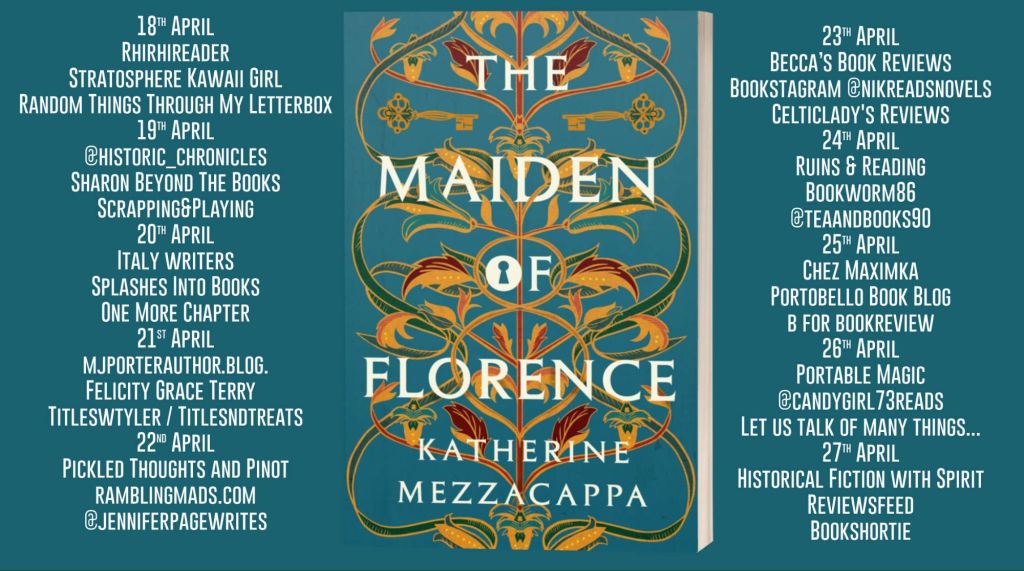
You can follow the rest of the blog tour here:
 Portable Magic