
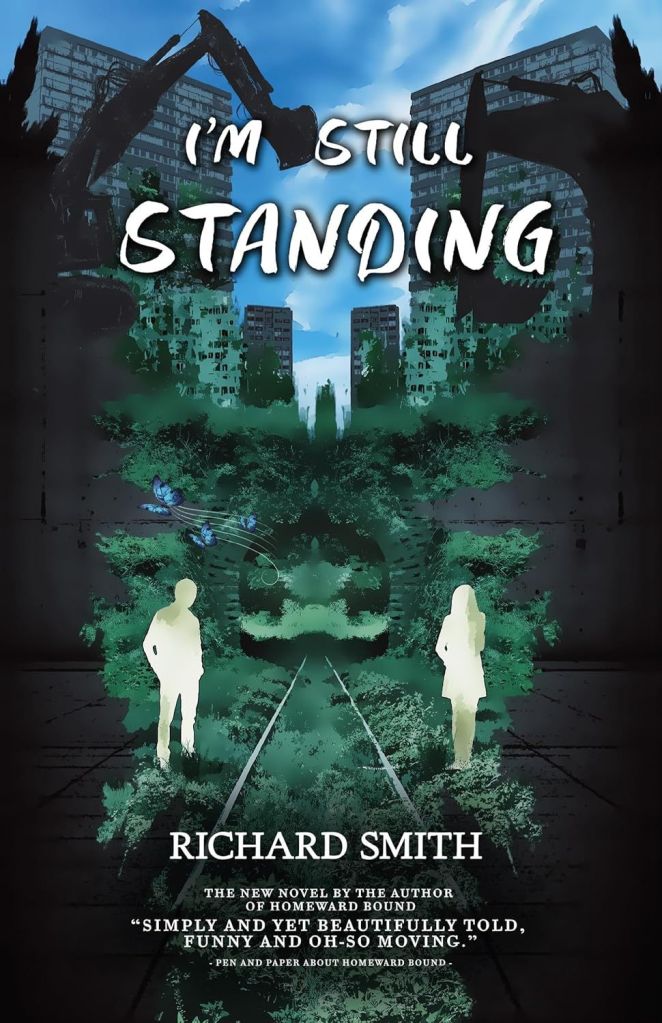
Today it’s my turn on the blog tour for I’m Still Standing. I’m sharing a guest post written by the author with thanks to Anne Cater for inviting me on the tour and to Richard Smith for writing the guest post.
Blurb:
Loved by wildlife, threatened by developers.
A heart-warming story of a reluctant and unlikely friendship between a pair of misfits,
whose futures become linked to the survival of an urban ‘greenspace’.
Two young people are struggling to find themselves and a role in life. For one, the world is changing too quickly. For the other, change can’t come soon enough. Linking them are overgrown railway sidings – home to wildlife but about to be destroyed.
Jill Standing is mocked because of her name, ignored because of the way she looks and thought wacky because of her views on the environment. Harry Pratt is mired in traditions foisted on him by his father. His interests are vintage jukeboxes, creating Christmas cracker jokes and his boss, Sarah. He has no interest whatsoever in the environment. They’re indifferent to one another, yet both want to preserve the sidings, but for different reasons. Campaigning against a big business, a shared love of Blondie and a reclusive, retired school-teacher transforms their lives.
Set in 1989, and with a backdrop of music, environmental concerns and nostalgia, it follows frustrating wrong turns to a surprising, heart-warming conclusion.
Guest Post:
Richard Smith writes about why he chose to set I’m Still Standing in 1989.
In 1989, if you’d bought an Apple Mac computer, it would most likely have a 20 MB hard drive. That’s ten photos on a modern mobile phone. And it had a 9-inch screen that was just black and white. A laptop, or portable as it was known, weighed around seven kilos – that’s the entire carry-on allowance for many airlines today. No wonder it was dubbed, ‘the Luggable’.
1989 is also the year I’ve set my new novel, I’m Still Standing. It was an age where there were kiosks on street corners selling newspapers and tobacco, petrol was measured in gallons, and you could buy a Marathon and Opal Fruits with the shopkeeper knowing what you meant. The price of a pint was 96p and, with luck, you could find a pub with a jukebox. But I’ve set my story in the eighties not just for the nostalgia – although there’s plenty of scope for it – but also because it was the year Margaret Thatcher stood in front of the United Nations General Assembly and declared, “Of all the challenges faced by the world community, one has grown clearer than any other in both urgency and importance — I refer to the threat to our global environment.”
Fine words! Yet, at the same time, threatening the environment at home, was one of her government’s policies – the regeneration of inner city areas by building on old industrial sites and railway yards and sidings. No matter that many had been colonised by woodland and become havens for wildlife. To politicians, it was land that was abandoned, derelict and disused. “Lying idle,” it was said. Pressure was put on local authorities to sell them as prime sites for developers. Not everyone agreed though, and a backlash followed. Locals protested, campaigning not only to protect and retain the sites but also to turn them into nature reserves, with access for the public.
Leading the fight would be Friends’ groups – except the fight was rarely friendly. Prospective developers of “good building land” in south London dubbed opponents to their scheme as a “left-wing regiment” who were trying to rescue a site just because it was “good for daisies.” In this case, like many others, the developer came out on top, after the Secretary of State ruled the bulldozers could go in.
Another problem was Friends were rarely harmonious. At the outset, a community could rail against a common enemy. But invariably, it would quickly became obvious how fragmented the community really was. An initial meeting would attract a big audience to a local hall, with everyone keen to have a say about how the developer’s plans were “a bad thing”. But when asked what’s a “good thing”, divisions would appear. Cue personal viewpoints and self-interest, with people vying for influence by exaggerating their knowledge and past achievements. When suggestions for campaigning were eventually made, they’d be unrealistic, with much name-dropping of celebrities, politicians and journalists who would be sure to want to help – but that nobody knew. Then the crunch. Who’d organise the campaign, create posters, design leaflets? Loud argument became shoe-gazing. The only voices now would sheepishly say, “I’d love to help but my work is very busy at the moment,” and, “I would get involved but if I can’t commit myself fully, so it’d best if I let someone else do it.”
Yet there were successes, thanks to the determination and energy of the committed few. Within a fox stroll of Kings Cross station is a nature park in Camley Street, with another beside the Arsenal stadium. And in west London, the fight to save Wormwood Scrubs led to a woodland area known as Lester’s Embankment, after a schoolboy who led the campaign.
The three main characters in I’m Still Standing are each touched by the threat to derelict but rewilded urban sites, but in different ways. Jill – late twenties – is passionate about saving one, although she seems to be having as little success with her campaigning as she does with sending to record companies cassette tapes of her singing in the hope of a big break. Then there’s Iris – long since retired as a teacher – who is an expert on flora and fauna but rarely gets out these days. And Harry – early thirties – loves the city and believes people who are fanatical about green spaces should move to the country.
Does any of it sound familiar? Wildlife sites continue to be threatened by development – just look at the headlines HS2 has created. And people don’t change. We still have interests, hopes, fears, dreams, disappointments, regrets, as we’ve always done, even if where and how we live are constantly evolving.
It was setting these contemporary characteristics and issues within the fast-moving, changing world of the eighties that made writing I’m Still Standing such a joy to write.
Though if I’d been using a computer from 1989, before I’d finished, I’d have run out of memory!
***
I’m Still Standing is available from Amazon.
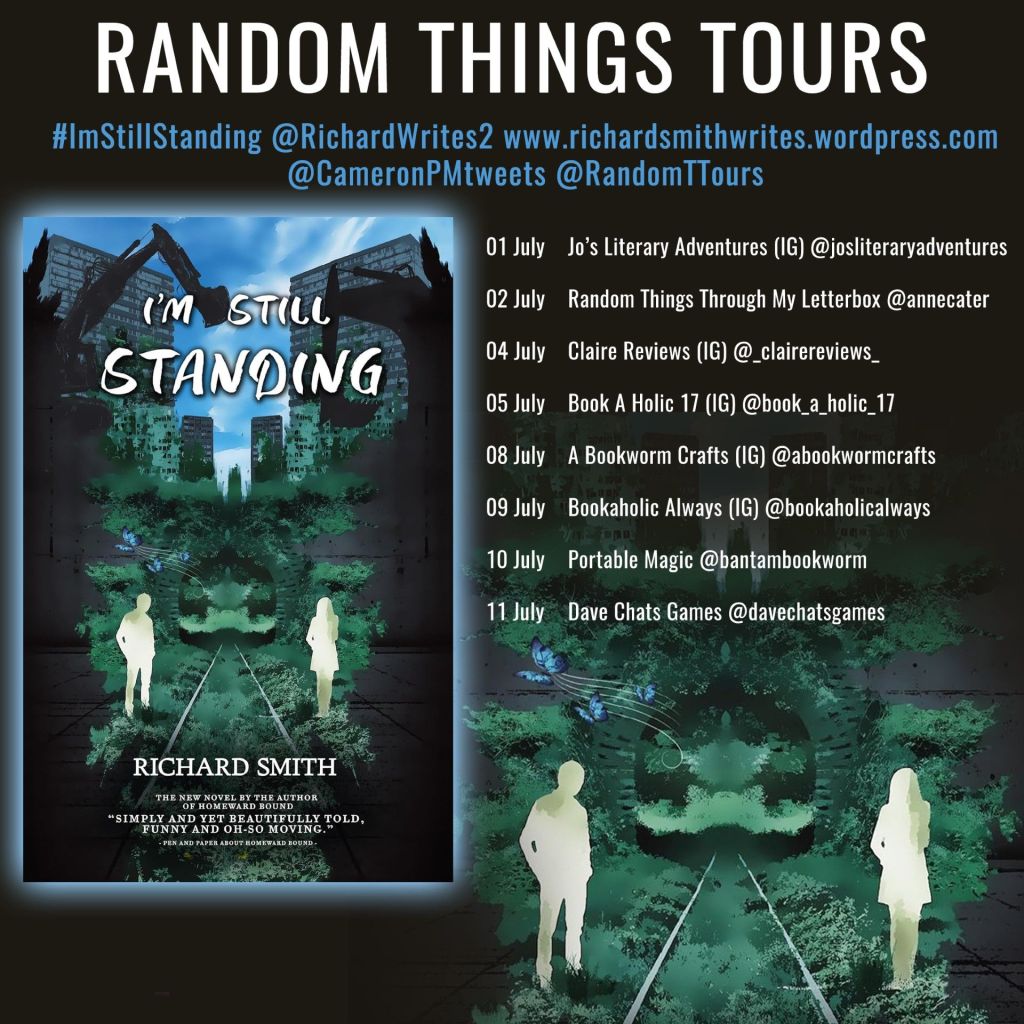
You can follow the rest of the blog tour here:
 Portable Magic