

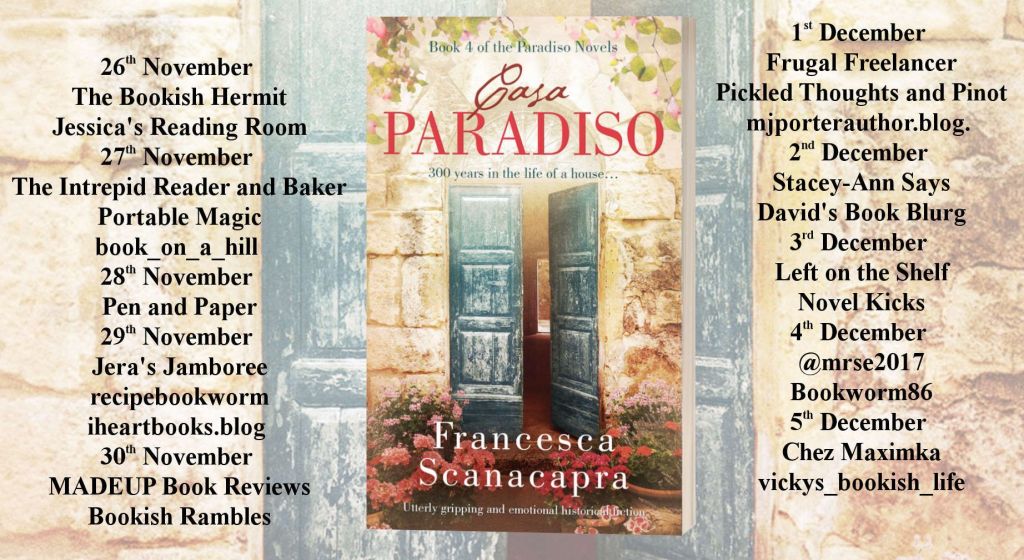
Today I’m joining the blog tour for Casa Paradiso. I’m sharing a guest post written by the author with thanks to Rachel Gilbey at Rachel’s Random Resources for inviting me on the tour and to Francesca Scanacapra for writing her guest post.
Blurb:
Lombardy, Northern Italy, 1637
Cristó Lovetta, a skilled stonemason, arrives in the rural village of Pieve Santa Clara to work on a nobleman’s house.
Haunted by a tragic past, Cristó wonders if he will ever find happiness again. However, as he immerses himself in his work, the warmth of the community and the beauty of the landscape convince him to begin a new life there.
Cristó designs and builds his own house, which he names Casa Paradiso. Over the centuries, Casa Paradiso becomes home to many generations, standing testament to lives beginning and ending, and witnessing the everyday challenges and triumphs of its inhabitants – from love lost and found, to the tragedies of war, the far-reaching consequences of political decisions made by powerful men and the evolving role of women in Italian society.
Casa Paradiso – the fourth instalment of the Paradiso Novels – is a shining, evocative saga spanning three hundred years in the life of a very special house, and a book that explores the enduring strength of the human spirit, contrasted with the transient nature of life itself.
Guest Post:
Francesca Scanacapra writes about maintaining momentum.
Maintaining Momentum
Keeping up creative momentum when writing a series of books can be a challenging task. While some elements must remain consistent to provide continuity, others need to evolve to make the story engaging. One of the crucial aspects is avoiding the repetition of themes and scenarios. Readers don’t want to feel as though they’re reading the same story over and over again.
The first three books in the Paradiso series – Paradiso, Return to Paradiso, and Daughter of Paradiso – are intimate first-person narratives that revolve around the life of Graziella Ponti, beginning in 1943 and leading up to 1965. The backdrop to these stories is a tiny village in rural Lombardy, and the house from which the books take their titles, Paradiso. Although I had plenty of ideas to continue Graziella’s story, I felt the need to bring a fresh perspective to the series. Thus the plan to frame the next book within the history of the house itself came about and Casa Paradiso was born.
Leaving my customary early to mid-twentieth century comfort zone opened up new avenues. Casa Paradiso begins in 1637 with the construction of the house and takes the reader on a journey through the subsequent three centuries. I chose to structure the book as a series of stand-alone stories, with each chapter focusing on a different era and a new character. This approach allowed me to maintain a connection to the previous books while bringing new themes to the series. Readers who have followed Graziella and the Ponti family’s journey in the earlier novels will find familiar references, while newcomers will be welcomed from a fresh entry point.
Furthermore, the shift from writing in the first person to the third person expanded the range of voices and perspectives available to me, thus enabling the exploration of a broader array of life experiences. In Casa Paradiso, we meet diverse characters, such as Cristó, the stonemason haunted by a tragic past; no-nonsense Carolina, who runs Paradiso as a guest-house; the very un-identical twins, Ugo and Moreno; and Costanza, who is at loggerheads with her wealthy landlords. Towards the end of the book, which covers the early part of the twentieth century, those who have read the previous novels will encounter some familiar names and faces, albeit in younger form.
In Casa Paradiso, the house transforms from a mere backdrop to a pivotal character which ties the generations together. Paradiso witnesses the joys, sorrows and transformations experienced by its inhabitants over the centuries. This allowed me to delve into themes of heritage and legacy and served as a poignant reminder of the transient nature of human existence. Whilst individual lives come and go, the house remains a constant, long outliving those who call it home.
Looking ahead, the Paradiso Novels will continue to evolve. While Graziella Ponti’s story will carry on, some of the new characters in Casa Paradiso may also have future novels dedicated to them. There are many Paradiso stories yet to be told.
***
Casa Paradiso is available from Amazon.
You can follow the rest of the blog tour here:
 Portable Magic